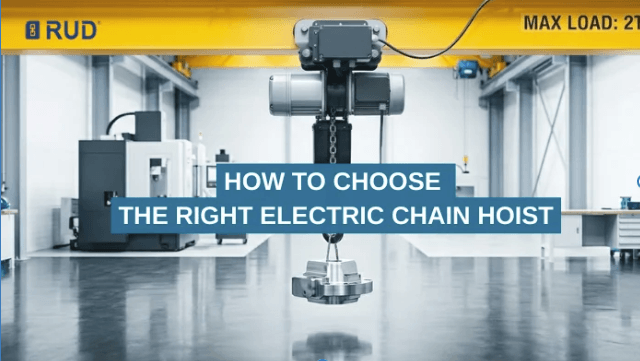
Electric chain hoists are widely used for lifting heavy loads in workshops and industrial settings. Choosing the right one starts with matching load capacity, lifting height, and duty cycle to your specific job.
If these factors don’t align, it can lead to equipment failure or costly downtime, and many buyers in Australia find the process confusing with so many options. At the same time, manual handling is still a major issue as it causes about 24% of all work-related injuries in the country. But a reliable electric chain hoist can help, by replacing physical strain with controlled, motorised lifting.
At RUD Engineering, we’ve spent over 40 years supplying industrial lifting systems from our Brisbane and Ipswich operations. And our experience has taught us what works in specific job conditions. So in this guide, we’ll break down the key details and help you choose the right hoist for your load, your site, and your budget.
Let’s start with how electric chain hoists compare to other lifting equipment.
Electric Chain Hoist vs. Other Lifting Equipment: What You Need to Know
An electric chain hoist provides powered, vertical lifting with precise load control. Whereas other tools like chain blocks, pallet trucks, and heavy vehicle hoists all serve different roles. Here’s how to tell them apart so you pick the right one for your site.
What Is a Chain Hoist and How Does It Work?
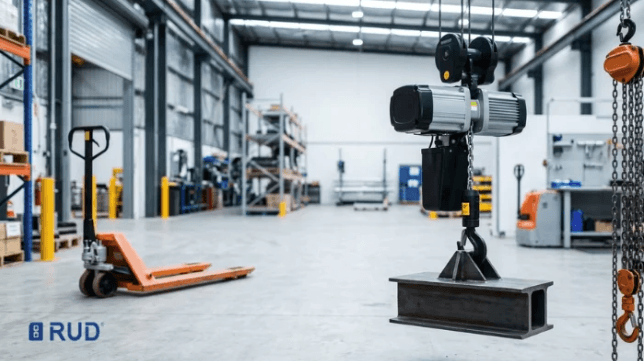
A chain hoist is a mechanical device that raises and lowers heavy items using a looped chain. In an electric model, a motor drives the chain, and a gearbox adds the power needed for heavier loads. Once the load reaches the required height, an electromagnetic brake holds it in place.
This setup gives you smooth, controlled vertical movement, even in small workshops or areas with low headroom. You’ll find these hoists across manufacturing plants, construction sites, and warehouses where workers need to lift materials safely and repeatedly.
Comparing Lifting Equipment Options
Each type of lifting equipment handles a different kind of task. And picking the wrong one usually means slower work, higher risk, or both. Below is a brief comparison so you can match the right tool to your needs:
- Electric Chain Hoist: If you need a lifting solution for repetitive tasks, a motor can do most of the heavy work for you. It’s particularly ideal for situations like assembly lines or busy warehouse operations where speed, control, and safety are important. Depending on the model, these hoists can handle between 1,000 kg and 5,000 kg.
- Manual Chain Blocks: For lighter or occasional loads, a hand-operated chain block can get the job done at a lower cost. However, the trade-off is that they’re slower, and without motor support, your team will carry more physical demand over a full shift.
- Pallet Trucks: If you need to move goods across a warehouse floor, pallet trucks are a reliable choice for horizontal transport. Just keep in mind they can’t raise materials vertically.
- Heavy Vehicle Hoists: These are purpose-built for raising trucks and other vehicles during maintenance. You’ll find them in workshops and defence settings, but they’re not designed for general industrial lifting.
So where does that leave you? If your job calls for vertical control, consistent speed, and safe handling of heavy loads, the electric chain hoist is the stronger choice.
Choosing the Right Tool for the Job
The right choice will depend on how the load needs to move. For example, if you’re moving goods across a warehouse floor, a pallet truck or cart can handle that just fine.
But if loads need to go up, stay in place, and land at a specific height, you’ll need an electric chain hoist. It’ll give you the positioning and control that manual tools can’t. A motorised hoist can also reduce the physical risk to your workers, especially in jobs that involve hard-to-balance loads or repeated overhead lifts.
Real-World Applications Across Industries
Electric chain hoists are commonly used in warehousing, construction, manufacturing, mining, and logistics. These environments often require teams to move heavy materials overhead in a controlled and reliable way.
So without the right equipment, work can slow down quickly. In many cases, workers start relying more on manual handling, which (as you can guess) increases injury risk and delays project timelines.
However, if you use a suitable hoist, it makes lifting safer and more efficient. Plus, it helps teams stay on schedule and keep operations running smoothly.
See also: TM SIM Registration 2026
How to Select the Right Lifting Equipment for Your Job
As mentioned earlier, you need to understand your loads, your environment, and how often you’ll use the equipment to choose the right electric chain hoist. So let’s look at how you can get it right the first time.
Start with the Right Questions
Before you start comparing products, take a step back and ask the basics:
- What are you lifting, and how heavy is it?
- How many lifts does your team do per shift?
- And what does the work environment look like?
Many buyers skip these questions and go straight to specs. That’s where costly mismatches happen. So we highly recommend understanding these fundamentals early to make everything else easier.
Key Factors to Consider
Once you know your requirements, it’s time to look at the details that can really affect performance. These are the factors worth paying close attention to.
Load Weight and Capacity
Always size your hoist to the heaviest load you’ll need to move. If you go too small, it can put your workers at risk because the equipment has to work beyond its limits.
On the other hand, going too large can waste money on capacity you’ll never actually use. The ideal choice is a hoist rated slightly above your maximum load, which will give you a safe buffer without overspending.
Lifting Height and Frequency
How far the load needs to travel is just as important as how heavy it is. Because different jobs place different demands on the equipment. For example, a site that runs dozens of lifts per shift needs a hoist with a stronger duty cycle than one used only occasionally.
And if your lifting height is beyond the standard range of three to six metres, you may also need an extended chain option to reach the right distance.
Environment and Industry Conditions
Dust, heat, moisture, and outdoor exposure all can wear down equipment fast. This means a hoist designed for a clean warehouse won’t hold up for long on a mining site or an open construction yard.
So if your environment is harsh, make sure the hoist you choose is rated to handle it.
Duty Cycle and Usage Intensity
A hoist rated for 2,000 kg doesn’t mean it can lift that load non-stop all day. The duty cycle will tell you how long the motor can safely run before it needs to cool down. It’s similar to endurance at the gym. Your maximum lift isn’t something you’d repeat over and over without resting.
The same logic applies here, and overlooking the duty cycle will lead to overheating, early motor failure, and unplanned downtime.
Control and Precision
Pendant controls are simple and reliable for standard vertical lifts. They hang from the hoist body and let your operator control the chain from ground level.
However, if your team needs more flexibility for positioning loads in tight or hard-to-reach areas, we recommend a remote control system. It’ll give your operators the freedom to work from a safer distance.
Safety Features
Good build quality usually comes with strong safety features, and these features can prevent accidents on site. For example, overload protection, limit switches, and electromagnetic brakes all work together to keep lifting safe and controlled.
In fact, most quality electric chain hoists include these features as standard, but it’s still important to check before you buy.
System Compatibility
Finally, your new hoist needs to fit with what you already have on site. That means checking whether it works with your existing overhead crane, jib crane, or workstation setup. Don’t forget to confirm that your power supply matches the hoist’s requirements as well.
If there’s a mismatch, it’ll lead to delays, rewiring costs, and frustration you could have avoided with a quick check upfront.
Get Safer Lifting Equipment for Better Results Every Day
So, did this guide make it easier to figure out which electric chain hoist fits your site?
After all, safe lifting and strong productivity are important in every industry. And that includes warehousing, construction, manufacturing, and mining. If your teams lift safely, they also improve efficiency and keep work more consistent.
RUD Engineering supplies a range of industrial lifting systems designed for Australian conditions. If you’re ready to find the right fit, have a chat with our team today.